
How the Rural Health Transformation Fund Creates New Strategic Opportunities for Laboratories

The One Big Beautiful Bill Act (H.R.1) created the federally sponsored Rural Health Transformation Fund (RHTF), positioned as a structural intervention in the healthcare delivery system for rural and underserved communities. The purpose of the RHTF is to support and strengthen care delivery systems in rural America.
However, H.R.1 also included substantial reductions to Medicaid funding. Rural hospitals are especially vulnerable to these cuts, as Medicaid represents up to 10% of their net revenue (Searing, 2026). In addition, nearly 200 hospitals have closed since 2025, with many more at risk due to the Medicaid shortfall (Lupin, 2026).
While the RHTF may not fully neutralize the impact of the Medicaid reductions included in the same legislation, it may partially offset those losses by giving states the resources to redesign and stabilize rural healthcare delivery.
The RHTF therefore represents more than supplemental funding. It provides states with a strategic tool to actively reform rural healthcare rather than simply react to financial losses and hospital closures. The program is intended to help states stabilize fragile systems while simultaneously reconfiguring care models to improve sustainability, access, and long-term health outcomes.
For clinical laboratories, the critical question is not whether rural healthcare will change, but whether laboratories will position themselves as essential infrastructure within that transformation.
Understanding the Rural Health Transformation Fund
The RHTF allocates $50 billion nationally to states over five years to support rural health systems.
Under the Act, each state receives a baseline allocation—approximately $100 million annually for five years—with additional funding available through a competitive process based on the strength and impact of each state’s transformation plan.
Many states, particularly those with large rural populations or healthcare deserts, have proposed initiatives that include:
expansion of telehealth services
deployment of advanced digital health technologies
workforce recruitment and training programs
modernization of healthcare infrastructure
The core pillars of the RHTF encourage states to realign healthcare systems around five priorities:
Prevention and chronic disease management
Workforce recruitment, training, and development
Improvement of rural healthcare infrastructure, including facilities and long-term operational sustainability
Creation of new care delivery systems and payment models
Modernization and deployment of innovation to improve patient access
Each of these pillars depends heavily on diagnostic services and laboratory data.
What This Means for Clinical Laboratories
Within the RHTF framework, laboratories should assert their role as foundational to the healthcare continuum.
Nearly every clinical pathway—whether focused on prevention, chronic disease management, or emergency care—relies on diagnostic testing. In rural communities where healthcare access is already fragile, reliable laboratory services often determine whether patients receive timely diagnoses and appropriate treatment.
As states redesign rural healthcare delivery systems, laboratories must proactively advocate for inclusion in workforce investments, infrastructure modernization, and technology deployment.
Laboratory strategy must be embedded in the overall rural transformation plan—not treated as an operational afterthought.
Decisions about rural healthcare redesign will occur whether clinical laboratory leaders are at the table or not. This is the moment for laboratory leadership to engage directly in state discussions, articulate the clinical and economic value of diagnostic services, and ensure that rural transformation includes the diagnostic infrastructure that makes modern medicine possible.
Examples of Fundable Laboratory Projects
CMS will distribute approximately $50 billion over five years, with states competing for additional funds based on specific transformation proposals.
The following examples illustrate how laboratories could serve as primary drivers of value within rural health transformation initiatives.
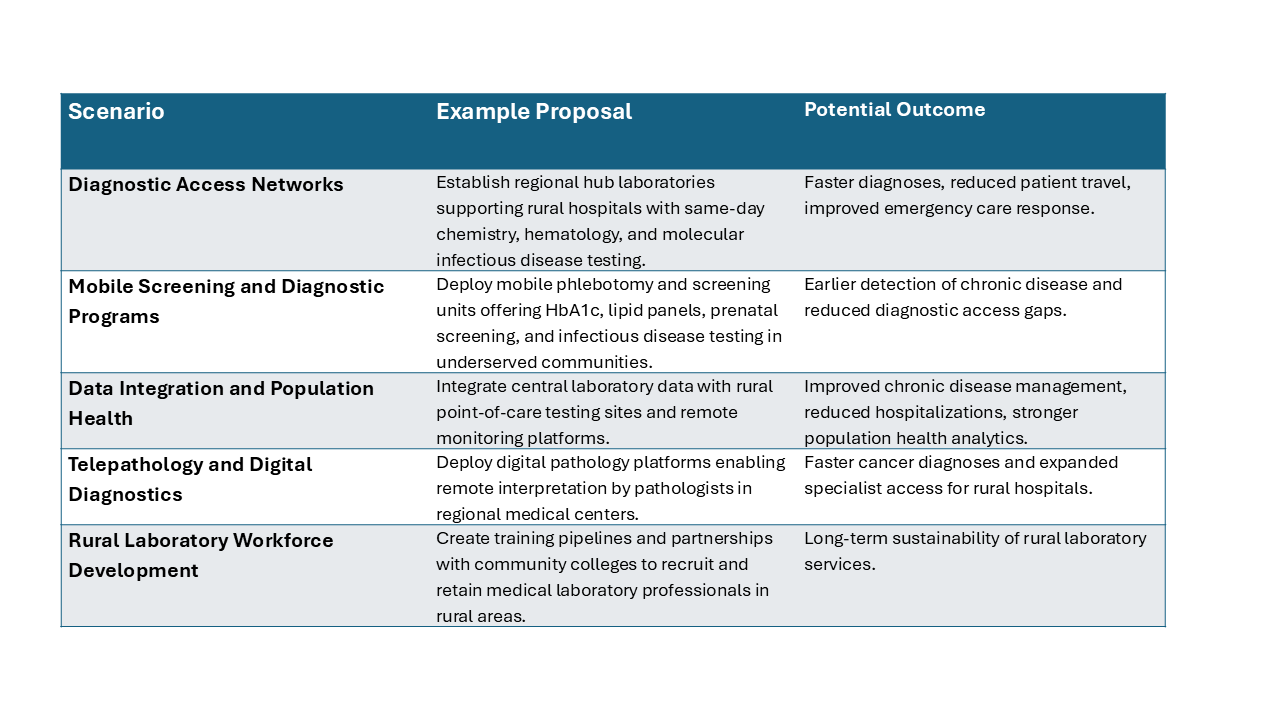
How Clinical Laboratories Can Engage in State RHTF Programs
Clinical laboratory leaders and professional laboratorians should actively monitor and participate in their state’s transformation planning efforts.
Steps to consider include:
Engage within your healthcare organization
Speak with leadership about your organization’s participation in RHTF initiatives.
Identify opportunities where laboratory services support transformation goals.
Monitor state policy activity
Track communications from state health departments and Medicaid agencies.
Many states are forming transformation task forces and holding stakeholder meetings.
Participate in regional healthcare forums
Attend meetings hosted by hospital associations and rural health coalitions.
These organizations frequently play central roles in proposal development.
Ensuring laboratory representation in these discussions is critical, as many transformation strategies will rely heavily on diagnostic services.
Driving Laboratory Impact
The RHTF provides laboratories with an opportunity to secure a stronger role within the evolving rural healthcare system. Funding allocated to states will inevitably involve diagnostic services, as laboratories generate the data that underpins clinical decision-making.
Both rural laboratories and urban laboratories serving rural communities may benefit from investments that support modernization, including:
instrumentation upgrades and automation
expanded molecular and infectious disease testing capabilities
digital pathology services to improve turnaround time
improved specimen logistics and courier networks
modernization of laboratory data and interoperability systems (LIS, EMR interfaces)
For clinical laboratories, the RHTF represents more than a funding opportunity. It may be a once-in-a-decade chance to reshape how diagnostic services support rural healthcare delivery, improving both patient outcomes and the long-term sustainability of rural healthcare systems.
References
Searing, A. (2026, March 6). The rural health transformation fund: Political rhetoric meets bipartisan concern as the program moves forward. Georgetown University McCourt School of Public Policy, Center for Children and Families
Lupkin, S. (2026, January 28). Here’s what to know about the $50 billion states are getting for rural health. NPR. https://www.npr.org/2026/01/28/nx-s1-5690370/rural-health-fund-states-hospitals